
Some buyers are insisting on a clause in the agreement that the whole deal hinges on physical verification at a later date with some part of payment kept in escrow.
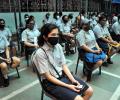
With the US education system operating independently from the government, universities are adopting varying strategies when it comes to Covid vaccination.

While there is a shortage of testing kits, manpower and capacities, India does not have other scalable testing options.

Amid the growing queues of ambulances waiting for patients to be admitted with ventilators and oxygen, only time will tell if the state government has lost the plot or not.

The second wave of the pandemic has not only crippled medical infrastructure in terms of hospital beds, but has also led to bottlenecks in invasive ventilators and medical oxygen capacities and supplies.

One challenge for many laboratories in ramping up is the shortage of trained manpower for collecting samples, report Sohini Das, Vinay Umarji and Virendra Singh Rawat.

Attributing the delay in debt servicing to a liquidity crisis, the company said its total indebtedness was Rs 518 crore.

'Going forward, whatever faculty positions we fill we expect to do so consistently with the quota requirements.'

With the Supreme Court not getting into the valuation part and leaving it to the two parties, lawyers said there was nothing much for Mistry Group to negotiate.

The entire proceeds from the sale of Reliance Centre will be utilised only to service YES Bank debt.

Even as lenders are getting ready to send more companies to bankruptcy courts from this week, several old cases are still awaiting resolution with no clarity on the completion of the process. This includes some high profile cases from the first list of 40 companies including Videocon Industries, Bhushan Power and Steel and Lavasa Corporation, sent by the Reserve Bank of India (RBI) for resolution. The delay is mainly due to litigation and late clarifications by various government agencies including the Reserve Bank of India and litigation by the Enforcement Directorate.

Of the 1,145 offers made this year, consulting firms made up 34 per cent, followed by banking, financial services and insurance, pharma/healthcare, IT/ITeS and FMCG/retail.

The recent report in the New York Times that China had brought India's financial capital - Mumbai - to a halt by hacking the electricity supply grid has not come as a surprise to the CTOs (chief technology officers) and cyber security experts. Indian companies, including critical infrastructure providers such as power grids, ports and radar systems, lack the IT infrastructure to prevent hacking from hostile state actors like China and North Korea, warn security experts. Recently, the United States government warned of yet another breach of critical systems tied to Microsoft Exchange email systems that the company has blamed on China. The breach has impacted thousands of organisations in the US and its impact on India is still unknown.

Indian corporate are fast tapping the international bonds market to raise funds for their operational expenses even as they reduce their presence in the rupee bond market. As bonds are costlier for companies and investors are more sceptical than the banks, chief financial officers say they are looking at other avenues for raising funds in the coming months as dollar bond rates are lower in the range of 100 to 250 basis points. "For corporate with reasonable credit quality, the Indian bond market has become less of an option from a cost point of view. "In addition, conditions imposed in the Indian bond market by investors post Franklin episode have also become very onerous," said Prabal Banerjee, president-finance of Bajaj group. "Hence very few corporate are looking at the local bond market for resource mobilisation, since both, bank loans and the overseas bond markets are much more attractive," he said.

'The hackers' objectives were centred around smearing India's reputation, causing productivity loss, creating operational damage and seeking financial gains.'

Unlike many other B-schools, IIM Ahmedabad follows a cluster system of final placements process where sectors are invited in cohorts at regular intervals.

172 firms participated in the final placement process.

'We are working in association with the state government and other transmission companies to make sure that the city never experiences blackouts'

When the lockdown was lifted last year, Rasikbhai Kotadiya, who runs a powerloom unit in the Kim-Pipodara industrial area on the outskirts of Surat, was left with only four workers out of the 48 that he used to employ to run his 128 looms. Though the economy had been unlocked, his textile unit, and that of thousands of others, struggled to resume operations. By the last week of May, nearly 700,000 of Surat's 1.2-1.5 million migrant workers, left high and dry with no pay during the lockdown, had returned home. In Laskana, another textile weaving hub in Surat, the powerlooms were all but silent, with only 2,000 of the total 55,000 looms churning out grey cloth at a snail's pace.

The highest compensation package for the Global MBA class at the S P Jain School of Management stood at Rs 43.9 lakh while that for the MGB programme was Rs 35 lakh.
 © 2026 Rediff.com - Investor Information - Advertise with us - Disclaimer - Privacy Policy - Sitemap - Feedback - About us - Terms of use - Grievances